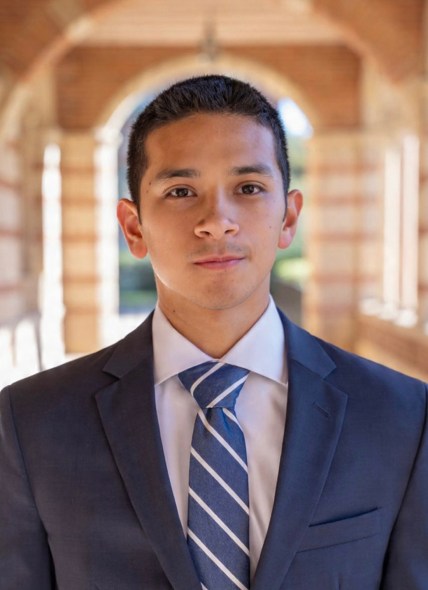
Hi Baby Bruins! We can’t wait to see you on campus!! My name is Matthew, and I’m a 3rd Year Mathematics/Economics student in the Economics Departmental Scholar Program. Originally from Fairfield County, Connecticut, I am also a proud out-of-state student who is excited to welcome you to “what is often cited as the only university founded in the 20th century to reach the top ranks of U.S. research institutions alongside schools like Stanford, Berkeley, and Harvard.”
I am currently involved in two research experiences on campus, and I want to share what the process looked like for me and what I’ve gained from each opportunity. For those of you who are interested in getting involved in research as an undergraduate, I hope the following can be helpful.
Department of Economics Board of Visitors Undergraduate Research Fellows Program
The first program I’ll highlight is the Department of Economics Board of Visitors Undergraduate Research Fellows Program. Applications typically open in September and close in early October, primarily for juniors and seniors. The process includes a resume, transcript, a one-page statement, and short responses, followed by faculty interviews. Decisions are usually released by the end of October.
I’ve completed one quarter in the program so far, working directly with an economics professor on a project combining econometric analysis and public conservation policy. This experience has helped me build technical skills (especially in R) while also developing the project management and organizational skills needed for academic research.
The program also includes career development workshops and opportunities to connect with alumni in fields like consulting, finance, and academia, and I’m most looking forward to presenting my research to the Economics Board of Visitors.
Center for Developing Leadership in Science (CDLS) Early Career Fellowship
In contrast, my experience with the Center for Developing Leadership in Science (CDLS) followed a less traditional path. It began during my first-year cluster course, where I took a seminar on communicating climate change taught by a CDLS Fellow. For my final project, I wrote an op-ed, which led to conversations with my instructor about my interests in science communication and policy.
That conversation turned into a summer role as a policy research intern with CDLS, and I later applied and was accepted as an Early Career Fellow.
Since then, I’ve worked on several climate policy and science communication initiatives, including contributing to the U.S. House of Representatives SEEC Institute’s Thriving Economies Project and creating the Thriving Futures Roundtable Series at UCLA. The series brings together fellows and community members to discuss research and collaborate on solutions to climate-related challenges.
More broadly, CDLS has shown me how research can extend beyond academia and connect directly with policy and community engagement, while also giving me the chance to develop interdisciplinary skills and real-world impact.
One final opportunity worth mentioning is the hands-on research embedded directly into many UCLA courses. While I can’t speak for every department, many classes are structured specifically to support collaborative, in-class research projects. For me, the idea of independently producing research can feel overwhelming. Developing a research question, identifying data sources, and designing a methodology are skills that take time to build. What I’ve appreciated most about these courses is joining a structured environment to practice those skills, with guidance from instructors and collaboration with classmates. They create space to experiment with ideas, make mistakes, and learn how research actually works before applying those tools to projects connected to my own academic


You must be logged in to post a comment.