
Hello! My name is Megan McKenna (she/her) and I am wrapping up my third year at UCLA studying Environmental Science with a minor in Environmental Systems and Societies. I grew up in Los Angeles, about 45 minutes from UCLA. On campus, I am a part of the Bruin Ambassador Program in which I visit local high schools and college fairs to chat about how much I absolutely love this school.

When I chose to go to a university close to home, I knew that I wanted to spend some of my education abroad. This spring quarter I realized that dream through the Tropical Biology and Conservation in Costa Rica study abroad program. This is one of many (over 150) programs offered by the University of California Education Abroad Program (UCEAP). If you are thinking about incorporating study abroad into your university experience this is likely an organization, you will come to know and love. UCEAP is one of a few different programs you can choose to pursue study abroad through at UCLA. The UCLA International Education Office does a wonderful job of explaining the different types of options you have, and I would urge students to visit the website’s Programs Overview as a start to their study abroad journey. My following step was exploring the programs listed on the UCEAP’s website and narrowing down my search. Some programs are heavily academically based while others focus on cultural immersion. The program filters on the website make it easy to explore all the different types of abroad experiences you can picture yourself having. If you are not entirely sold on studying abroad, the UCEAP website may change your mind (the programs are extremely enticing). Next, I arranged a meeting with a representative from the International Education Office (IEO) where I voiced what my ideal study abroad looked like (focus, time of the year, countries of interest, etc.) and determined which program I wanted to apply to, how to prepare myself for the travel, and different scholarship opportunities to make studying abroad affordable. I knew I wanted my program to have a focus on Environmental Science, I wanted to practice a third language and have a unique experience that could not be mirrored just by traveling to another country.
Incorporating study abroad into your university experience is feasible but does require some thought and planning. Majors that have capstone projects, such as the Environmental Science major, likely will not permit students to study abroad in their final year. These are things you should look out for. After meeting with the IEO officer, I called my counselor to see what credits I could apply from my time abroad to my major. In doing this I was able to comfortably study abroad during the academic year and have units effectively count towards my major just as if I was taking classes in Westwood.
The Tropical Biology and Conservation in Costa Rica program offers a very dynamic and immersive education experience. The first two weeks of the program are field trips. After landing in Costa Rica, we headed to the Osa Peninsula for a week and then to Santa Rosa National Park in the Guanacaste region for the second half of the field trip. After being on the move for the first portion of the trip, we settled at the Estación Biológica in Monteverde, a natural reserve station dedicated to nature lovers and learners, where we explored living in the cloud forest. After a month of being settled at the Estación Biológica, we packed up again for a homestay, followed by a week of backpacking into the San Gerardo field station in the Children’s Eternal Rainforest. The homestay portion effectively allows students to connect to the community and practice their foreign language skills. In summary, I am getting the incredibly unique experience that I wanted and a chance to be immersed in environmental studies through a multitude of climates.
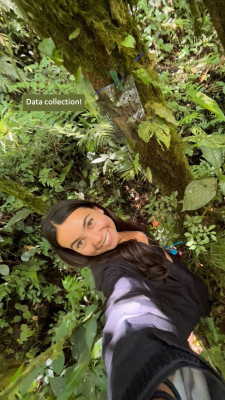
Most of my courses abroad consist of field days and hands-on learning experiences. Our agroecology course has allowed us to visit various small local farms and even bottle-feed a calf. I never pictured that my courses would be conducted on a boat during a snorkeling break or while kayaking through the mangroves until I arrived here. My personal highlight of this program has been the opportunity to do an independent research project in an area of your choosing. Students elected projects that spanned from working with bats to studying bio-inflorescence in the small fishing village of Cuajiniquil, Costa Rica. I chose to study lichen and bryophyte distribution in the Monteverde cloud forest and got to spend full days walking through the rainforest collecting data. This experience reinvigorated my love for learning and combined my passion for the outdoors with my education.
Every program is unique in its opportunities and experiences. I cannot recommend this program enough to students interested in ecology and environmental science with a knack for outdoor activities. If you find yourself more comfortable in a city atmosphere there is also an opportunity to fulfill that wish. If you want to make studying abroad a part of your college experience, try and plan early on. Anticipate that there might be changes in your major, classes, and schedule that could change your plans. It was really helpful for me to organize my classes and degree beforehand so that I felt comfortable taking the time away from campus. The skills and adventures that I have gained from studying abroad have supplemented my college experience beyond imagination.
 UCLA Bruin Blog
You must be logged in to post a comment.